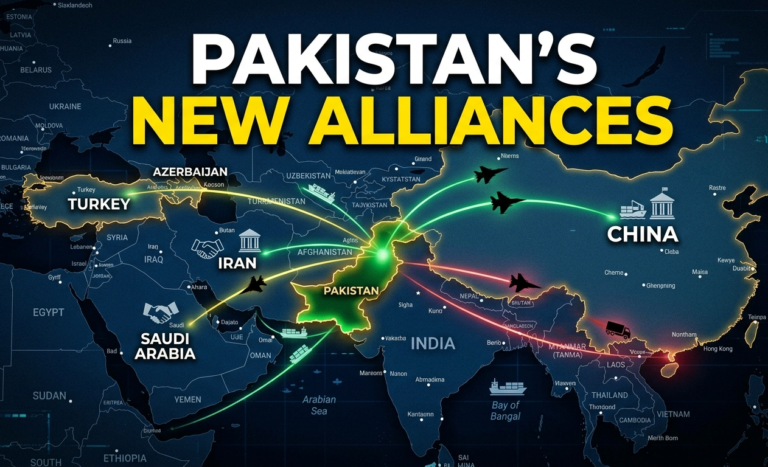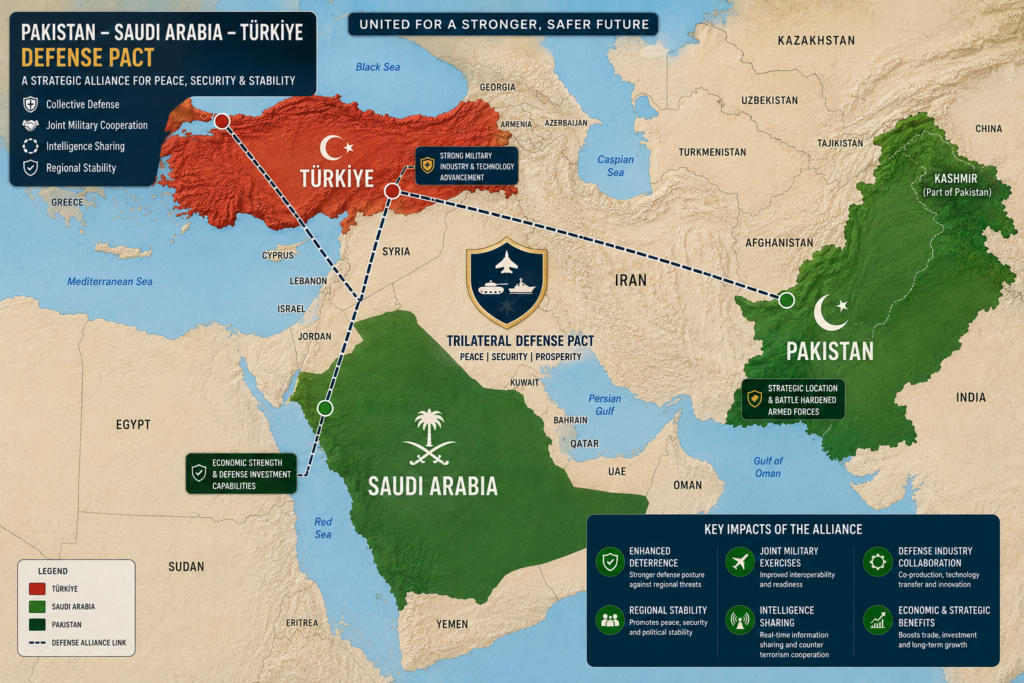
A reported defence agreement between Pakistan, Saudi Arabia and Türkiye is being presented by supporters as more than a military pact. They see it as a possible foundation for a new security system across West Asia.
The central idea is simple: regional countries should protect one another, solve disputes through dialogue and reduce their dependence on outside military powers.
According to the account presented in the source material, the agreement focuses on collective security, collective deterrence, defence cooperation and technology sharing.
That could have major consequences.
What the Defence Agreement Means
Under the reported framework, the three countries would strengthen cooperation when facing external security threats.
The agreement is also described as supporting joint defence projects and technology sharing.
The most important point is collective deterrence. In practical terms, a threat against one partner could become a concern for all three.
For Pakistan, Saudi Arabia and Türkiye, that could increase their diplomatic and military influence.
It could also change how other governments calculate the risks of confrontation in the region.
Pakistan Could Gain a Bigger Regional Role
Pakistan appears central to the vision outlined in the source account.
Islamabad already has close military ties with several Muslim-majority countries. Pakistan is also the only Muslim-majority state known to possess nuclear weapons.
Supporters of deeper regional cooperation therefore see Pakistan as a country capable of providing military expertise, training and strategic support.
Pakistan’s role could move beyond traditional bilateral defence relationships toward building a wider network of security partnerships.
That would strengthen its position in the Muslim world.
A New Model for West Asia?
The larger concept goes beyond the three countries.
The source describes a security model based on the idea that countries inside the region should play the leading role in deciding how regional security works.
That approach emphasizes dialogue, sovereignty and cooperation under international law.
It also reflects a broader debate over the future role of the United States and other outside powers in West Asia.
For decades, regional security has depended heavily on American troops, military bases and security partnerships.
A stronger regional framework could gradually change that balance.
Iran and Israel Remain Important Factors
The agreement is also being discussed against the backdrop of tensions involving Iran and Israel.
Some observers may interpret closer cooperation among Pakistan, Saudi Arabia and Türkiye through that rivalry.
However, the source argues that the initiative should instead be understood as part of a broader collective-security system that could eventually involve additional countries.
That distinction matters.
If the framework remains open and focused on regional stability, it could become a diplomatic platform rather than simply another military bloc.
Much will depend on implementation.
Defence agreements can make powerful political statements. Turning them into lasting security systems is much harder.
Still, closer cooperation among Pakistan, Saudi Arabia and Türkiye could become an important development in the changing strategic landscape of West Asia.
The key question is no longer only what the three countries have agreed to do.
It is how many others may eventually join them.
About The Author